

A few weeks ago, at one of our events, a business owner came up to me looking visibly frustrated. His company was doing well, good product, decent leads coming in, but his sales team just couldn’t close.
“Jitesh,” he said, “my salespeople are not able to convince people to buy our product. They know the product inside out. They’re hardworking. But deals keep slipping away.”
I asked him one question: “How many questions do your salespeople ask on a sales call?”
He paused. “I don’t know… maybe 4 or 5?”
That’s when I knew exactly what the problem was.
His team wasn’t losing deals because they couldn’t convince. They were losing because they weren’t asking the right questions.
The Real Problem: Your Salespeople Are Pitching, Not Diagnosing
Most salespeople think closing is about convincing. It’s not.
Closing is about diagnosing the customer’s problem so well that the solution becomes obvious.
Think about it like this: when you go to a good doctor, do they immediately prescribe medicine? No. They ask questions. They probe. They listen. They diagnose. Only then do they prescribe.
But most salespeople walk into a call ready to pitch. Ready to present features. Ready to “convince.”
And that’s where the leak happens.
You’re pouring leads into your sales funnel, but if your team doesn’t know how to diagnose, those leads are leaking out the bottom. This is what I call the leaking pot problem, and it’s costing Indian SMEs doing ₹1 Cr+ revenue lakhs every month.
The fix isn’t more leads. It’s better closing. And better closing starts with better questions.
What Harvard Research Reveals About Top Sales Closers
Here’s the game-changer: Harvard research studied hundreds of sales calls and found something remarkable.
Top sales closers ask 11-14 deep questions per call.
Average performers? They ask only 3-4 basic questions.
That’s it. That’s the difference.
It’s not about charisma. It’s not about years of experience. It’s about how many questions you ask, and more importantly, what kind of questions you ask.
Questions are diagnosis. Diagnosis builds trust. And trust closes deals.
When a customer sees that you’re genuinely interested in understanding their problem, not just selling your product, they open up. They share the real pain. And that’s when the sale happens.
Why Most Salespeople Ask Weak Questions
Most sales training focuses only on product knowledge, handling objections, and presenting features and benefits.
But no one teaches them how to diagnose.
So they walk into calls with a pitch in their head. They ask 2-3 surface-level questions like “What are you looking for?” or “What’s your budget?” and then they jump straight into the pitch.
The result? Surface-level conversations. No trust. No deep understanding. And no sale.
Your salespeople aren’t lazy. They just don’t know what to ask or how to layer their questions to get to the root of the problem.
How to Train Your Sales Team to Ask Deep, Trust-Building Questions
If you want your team to close more deals, you need to train them to ask better questions. Here’s how.
Step 1: Shift the Mindset – From Pitch Mode to Diagnostic Mode
Your salespeople need to stop thinking like salespeople and start thinking like doctors.
A doctor doesn’t walk in and say, “Here’s the prescription.” They diagnose first.
Your team needs to adopt the same approach: “I’m here to understand your problem, not to sell you something.”
When that mindset shift happens, the entire sales conversation changes.
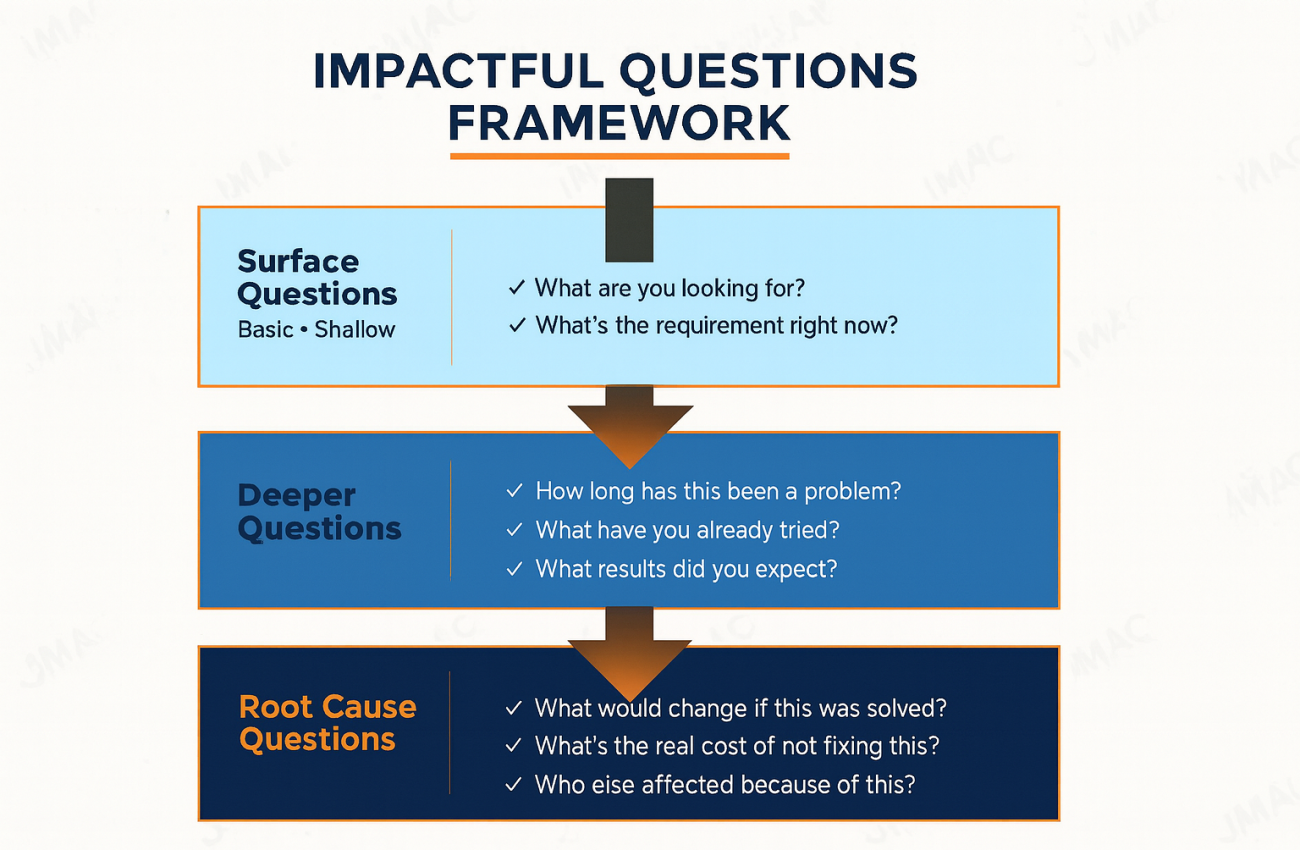
Step 2: Build a Question Framework
Here’s a framework that sound simple, but works great.
Layer 1: Start Broad
“What’s the biggest challenge you’re facing right now?”
“What’s not working the way you want it to?”
These questions open the door. They get the customer talking.
Layer 2: Go Deeper
“How long has this been a problem?”
“What have you tried so far?”
“What didn’t work about those solutions?”
Now you’re peeling back layers. You’re moving from surface symptoms to deeper issues.
Layer 3: Get to Root Cause
“What would change for you if this problem was solved?”
“What’s the real cost of not fixing this, not just money, but time, stress, lost opportunity?”
“If you could wave a magic wand, what would the ideal solution look like?”
These questions hit the emotional core. They make the customer realize the true cost of inaction. And that’s when urgency kicks in.
By the time you’ve asked 11-14 questions across these three layers, you’re not guessing what the customer needs. You know.
Step 3: Role-Play & Practice
Set up weekly role-plays. Record actual sales calls. Review them together. Ask: “How many questions did we ask? Were they deep or surface-level? Did we diagnose or did we pitch too early?”
Reward curiosity, not just closures. When someone asks a great question that uncovers a new pain point, celebrate it.
Over time, this becomes second nature.
What Happens When You Get This Right
When your salespeople start asking deep, layered questions, everything changes.
Customers open up. They share real pain, not polite objections.
They feel understood. And when someone feels understood, trust is built during the call, not after weeks of follow-up.
Your close rate improves. Not because your team got better at “convincing,” but because they diagnosed correctly. When the diagnosis is right, the solution becomes obvious.
It’s not magic. It’s a method.
Key Takeaways
- Top sales closers ask 11-14 deep questions per call; average performers ask only 3-4
- Closing isn’t about convincing, it’s about diagnosing the customer’s problem
- Train your team to layer questions: surface to deeper to root cause
- Trust is earned when the customer feels understood, not sold to
- Role-play, record calls, and coach your team weekly to build this skill
FAQs
Q: What if my salesperson talks too much and forgets to ask questions?
A: Record their calls and play them back. When they hear themselves, they’ll realize the problem. Then role-play and practice asking questions before pitching.
Q: How do I know if my team is asking good questions or bad questions?
A: Good questions make the customer think and open up. Bad questions can be answered with “yes,” “no,” or one word. Listen to your team’s calls and check.
Q: Will asking so many questions make the call too long?
A: No. Deep questions actually save time because you diagnose faster and don’t waste time pitching the wrong solution.
Q: Can I teach this to new salespeople or is it only for experienced ones?
A: You can teach this to anyone. In fact, it’s easier to train new salespeople this way because they don’t have bad habits to unlearn.
Final Thought
Whether you’re a business owner in Mumbai, Ahmedabad, Bangalore, Delhi, or any other city in the country, if your sales team is struggling to close, it’s not a motivation problem. It’s a method problem. And methods can be fixed.
The world gives you gyaan. At JMAC, we help you implement.
If you found this helpful and need support with closing more deals, improving your sales process, or training your team to ask the right questions, connect with us at jiteshmanwani.com.