
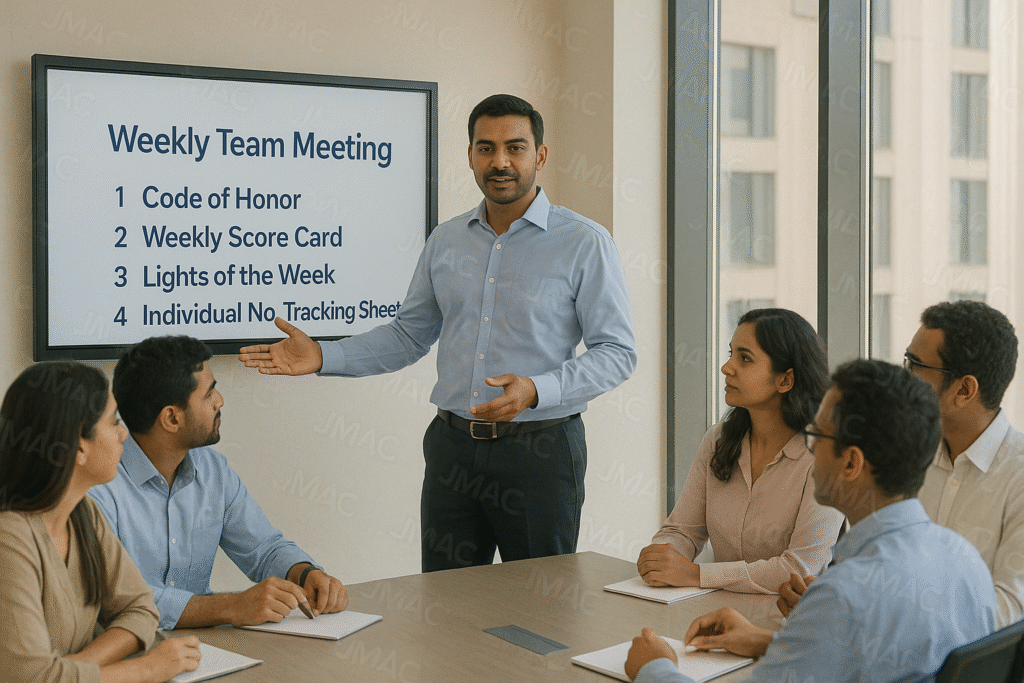
I used to dread Monday morning meetings.
Half the team was on their phones. The other half was mentally checked out. We’d discuss the same issues week after week: tasks not done, deadlines missed, miscommunication everywhere.
Every time I’d walk out thinking, “What a waste of an hour.”
Here’s what I realized: The problem wasn’t the meeting. It was the lack of structure, accountability, and consequence.
That’s when I built a 8-system framework that transformed how my team operates. But first, let me explain why you even need a weekly team meeting.
Why You Need a Weekly Team Meeting
If you don’t have a structured weekly team meeting, you’re running your business on hope and assumptions.
Here’s what happens without weekly alignment:
Everyone works in silos. Sales doesn’t know what marketing is doing. Operations fixes problems that could’ve been avoided.
Issues become fires. A client threatens to leave before you even knew they were unhappy. A team member quits before you realized they were demotivated.
No progress tracking. You’re making gut-feel decisions instead of data-driven ones.
Accountability disappears. Without public accountability, tasks slip and you end up chasing everyone.
Culture erodes. Politics creep in. Backbiting starts. People stop helping each other.
A weekly team meeting is the heartbeat of your business. It’s where you align vision, track performance, and build accountability.
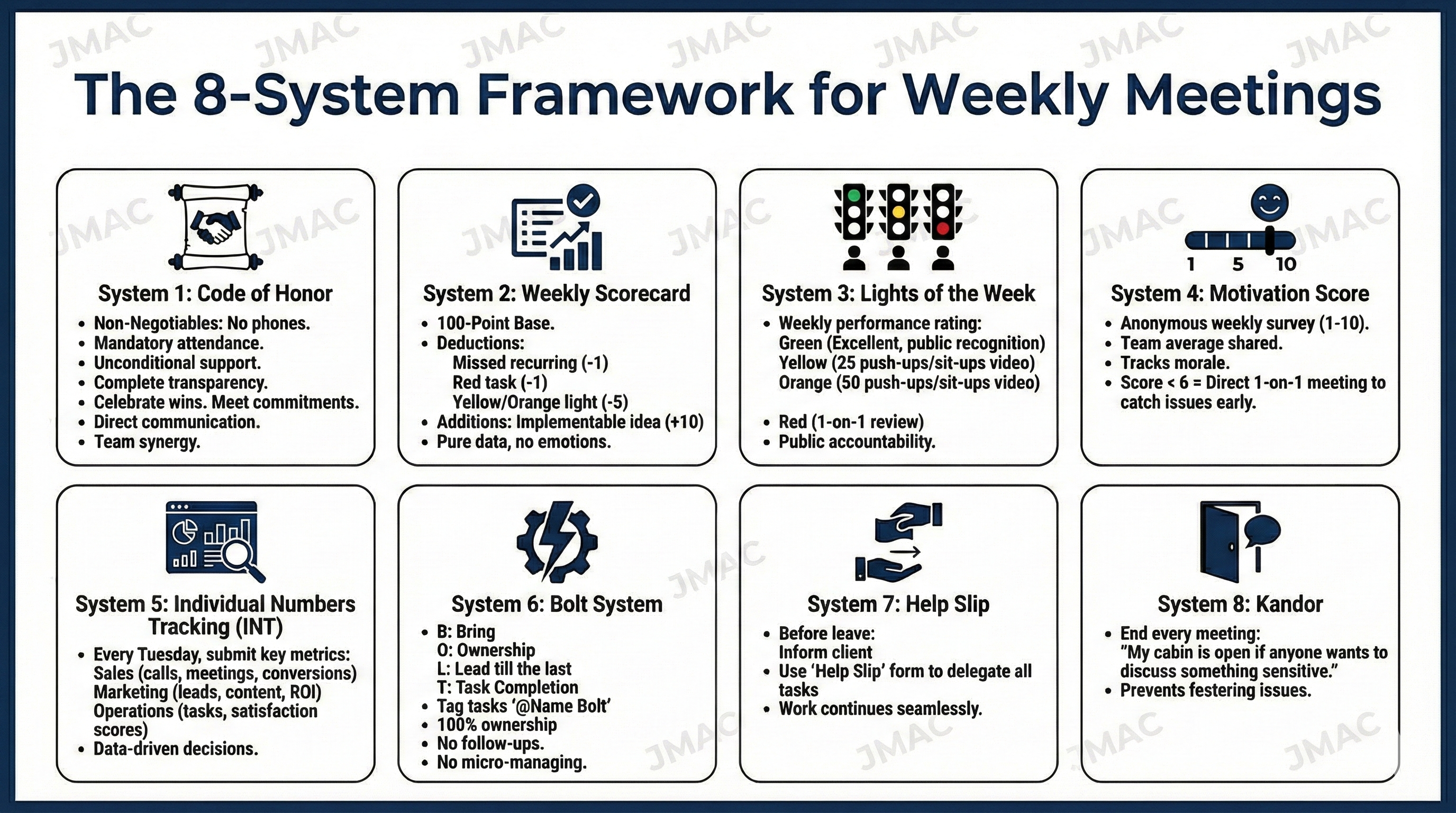
System 1: Code of Honor (Non-Negotiables)
Start with non-negotiable values:
- No phones in meetings (separate table)
- Mandatory attendance (miss 3 = review)
- Unconditional support (help when available)
- Complete transparency (disclose conflicts)
- Celebrate small wins
- Meet commitments (communicate early if you can’t)
- Direct communication (no politics)
- Team synergy (win/lose together)
System 2: Weekly Scorecard (100-Point Base)
Everyone starts with 100 points each week.
Deductions: Missed recurring task (-1), Red task (-1), Yellow/Orange light (-5)
Additions: Implementable idea (+10)
Scores revealed weekly. Pure data, no emotions.
System 3: “Lights of the Week”
Weekly performance rating:
- Green: Excellent (public recognition)
- Yellow: Post 25 push-ups/sit-ups video
- Orange: Post 50 push-ups/sit-ups video
- Red: 1-on-1 review
Public accountability without toxicity.
System 4: Motivation Score
Anonymous weekly survey (1-10 scale). Coordinator collects and shares team average.
Tracks morale before burnout hits.
Important: If anyone’s score is below 6, they sit down with me directly in my cabin to discuss what’s going on. This ensures we catch issues early before they become bigger problems.
System 5: Individual Number Tracking (INT)
Every Tuesday, submit key metrics:
Sales: calls, meetings, conversions
Marketing: leads, content, ROI
Operations: tasks, satisfaction scores
Data-driven decisions only.
System 6: “Bolt” System
B : Bring
O : Ownership
L : Lead till the last
T : Task Completion
Tag tasks with “@Name Bolt”. You’re out of the loop. They own it 100%.
No follow-ups. No micro-managing.
System 7: “Help Slip”
Before leave:
- Inform the client of the upcoming leave.
- Use the “Help Slip” form to delegate all tasks to a team member.
Work continues seamlessly.
System 8: “Kandor”
End every meeting with: “My cabin is open if anyone wants to discuss something sensitive.”
Prevents festering issues.
What Happens When You Implement This
Your team will resist initially. But when you stick with it:
- Meetings become productive
- Team takes ownership
- No more excuses
- Culture shifts to proactive
- You get your time back
Implementation Checklist
- Create Code of Honor
- Set up Weekly Scorecard
- Launch Lights of the Week
- Track Motivation Score
- Build Individual Numbers Tracking sheet
- Use Bolt for ownership
- Implement Help Slip for task delegation
- Open Kandor weekly
- Start conducting meetings every single week
Frequently Asked Questions
Q: Do I need to implement all 8 systems at once?
No. Start with the Code of Honor and Weekly Scorecard. Add the others gradually over 1-2 weeks.
Q: How long does each weekly meeting take?
45-60 minutes if you stick to the agenda. The structure keeps it tight.
Q: What if my team doesn’t take the Lights system seriously?
Start by celebrating Green lights for the first 2-3 weeks. Build the positive culture first, then introduce consequences.
Q: Can this work for remote teams?
Absolutely. Use Zoom for meetings, Google Sheets for scorecards and tracking sheets, and WhatsApp for Lights videos.
Q: What if someone consistently gets Yellow or Orange lights?
That signals a coaching opportunity or a role-fit issue. The system helps you catch problems early before they become toxic.
Final Thought
If you’re a business owner in Bangalore, Pune, Surat, Ahmedabad, Mumbai, Hyderabad, Chennai, or Delhi NCR, you know building accountability without toxicity is hard.
This framework works because it’s structured, fair, and transparent.
The world gives you gyaan. We help you implement.
If you found this helpful and need help implementing this in your company, connect with us at jiteshmanwani@gmail.com.