

9One time, one of my clients comes to me and says, “Jitesh, meetings bhar-bhar ke kar raha hun, par deals close nahin ho rhi hai.”
I ask him, “Accha, meeting mein kya kar rahe ho?”
He says, “Sir, PPT banayi hai hamari service ki, wohi dikha rahe hain.”
I told him straight – “Wohi toh galti kar rahe ho.“
And this isn’t just him. Almost every business owner I meet is making the same mistake and then wondering why their conversion rate is stuck at 10-15%. They think the problem is their product, their pricing, or their marketing. But the real problem? Their sales meetings feel like board presentations, not conversations.
Let me tell you something I’ve learned after working with hundreds of Indian SMEs: If you want to close deals, you’ve got to make the conversation informal – and fast.
The Big Mistake: Your PPT Is Killing Your Deals
Here’s what happens in most sales meetings:
You open your laptop. You share your screen. You start clicking through slides. Slide 1: “About Us.” Slide 2: “Our Services.” Slide 3: “Why Choose Us?” Slide 4: Case studies with graphs.
And while you’re clicking, the client is sitting there – polite, nodding, but mentally checked out.
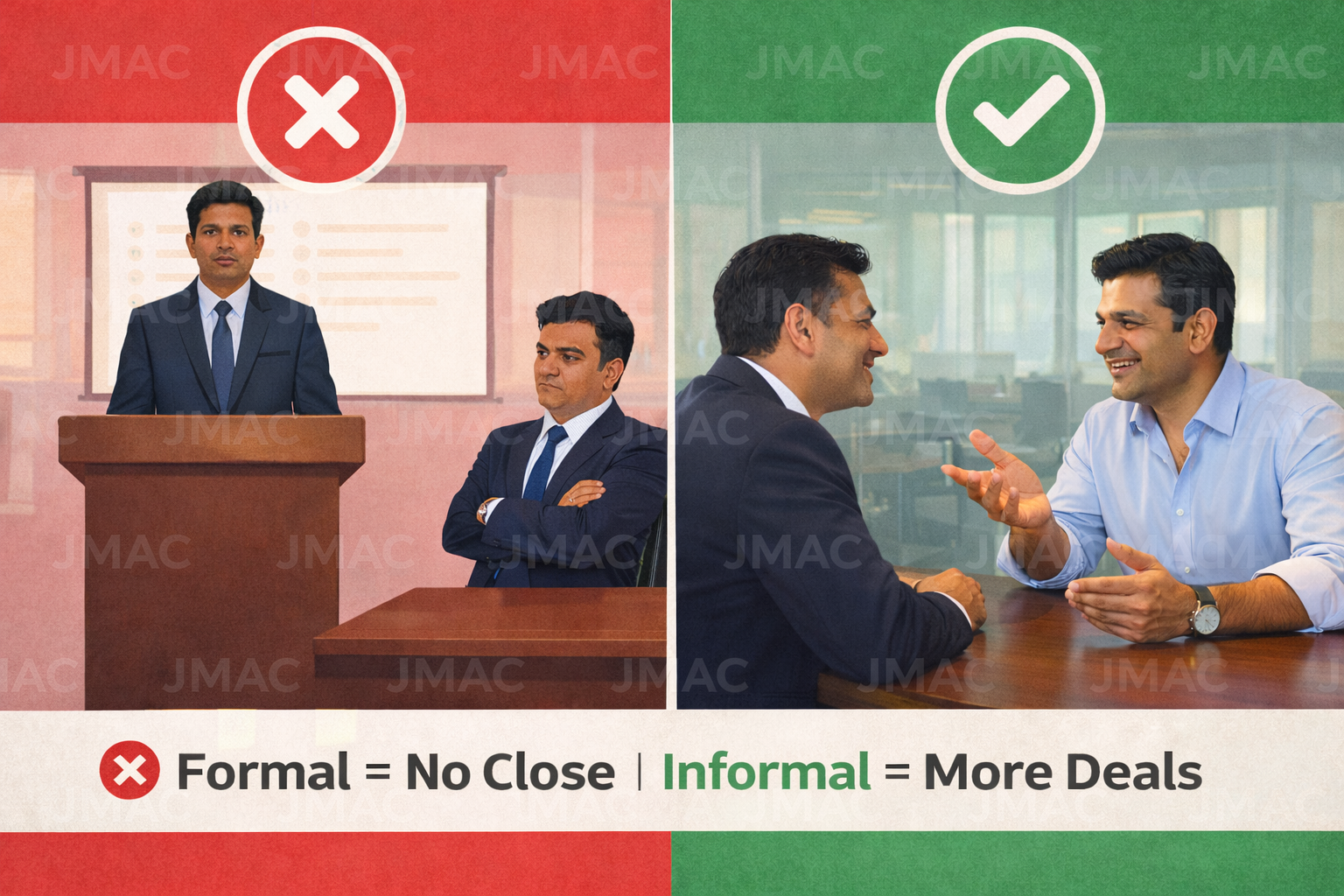
Why? Because the moment you pull out a presentation, the meeting becomes formal. And formal meetings don’t build trust. They build distance.
Think about it. When was the last time you bought something expensive from someone who made you sit through a slideshow? You didn’t. You bought from the person who talked to you like a human being, who understood your problem, who shared a story that made you think, “Haan yaar, yeh banda samajhta hai.”
Would you propose marriage with a PowerPoint? No, right? Then why are you trying to close a ₹5 lakh deal with one?
Why Informal Conversations Close More Deals
People don’t buy from presentations. They buy from people.
And trust – real trust – is built in conversation. Not in bullet points. Not in feature lists. Not in “our company was founded in 2015 and we have 47 clients.”
At JMAC, we teach a simple principle: If you want to close, make it informal as quickly as possible.
What does that mean? It means your sales meeting should feel less like a pitch and more like chai with a friend who’s giving you solid advice. You’re not there to “present.” You’re there to have a real conversation about their problem and how you can solve it.
The more informal the vibe, the more the client opens up. The more they open up, the more you understand their real pain. And the more you understand their pain, the easier it is to position your solution as the obvious answer.
How to Turn Your Sales Meetings from Presentations into Conversations
Alright, so no more PPTs. Then what? Here’s exactly what to do:
1. Ditch the Deck (Or Use It Sparingly)
I’m not saying delete your presentation. Keep it. But don’t lead with it.
Your PPT should be a reference tool, not your script. If the client asks, “Do you have something I can see?” then sure, pull it up. But even then, don’t read from it. Use it as a guide while you talk.
The goal is simple: You control the conversation. Not the slides.
2. Turn Every Feature into a Story
This is the game-changer.
Take every point in your offer—every feature, every benefit, every differentiator—and turn it into a case study or anecdote.
For example, instead of saying, “We provide 24/7 customer support,” say this:
“Let me tell you about one of our clients—a logistics company in Pune. They were losing ₹2 lakh a month because their previous vendor’s support team was only available during office hours. One night, their system crashed at 11 PM during peak season. They called us, we fixed it in 30 minutes. That one incident saved them ₹8 lakh in potential losses. That’s why we’re available 24/7.”
See the difference? One is a bullet point. The other is a story that shows credibility, builds trust, and makes your offer real.
3. Ask More, Talk Less
Most salespeople talk too much. They’re so excited about their product that they forget to listen.
Here’s the rule: In the first 10 minutes of any meeting, ask at least 3 open-ended questions.
- “What’s the biggest challenge you’re facing right now?”
- “What have you tried so far to fix this?”
- “If I could wave a magic wand and solve one thing for you today, what would it be?”
Listen to their answers. Really listen. Then respond with a relevant story or insight. This isn’t about pitching. It’s about diagnosing.
4. Make It Feel Like Chai, Not a Boardroom
Language matters. Body language matters.
If you’re sitting stiff, talking in pure English with zero warmth, and keeping everything “professional,” you’re losing.
Use relatable phrases. Say “hum,” “aap,” “dekhiye.” Smile. Lean in. Mirror their body language. If the client is relaxed, you relax. If they crack a joke, laugh.
The moment the meeting feels stiff, you’ve lost the deal. Make it human.
What to Do Right Now
Here’s your action plan:
- [ ] Open your current sales deck. Pick 3 features. Turn each one into a 2-minute story.
- [ ] Practice one story out loud before your next meeting.
- [ ] Set a new rule: No screen-sharing in the first 10 minutes. Just talk.
- [ ] In your next meeting, ask 3 open-ended questions before you pitch anything.
- [ ] After every meeting, ask yourself: Was it formal or informal? Did I close or get a clear next step?
Key Takeaways
- PPTs make meetings formal – and formality kills trust.
- People buy from people, not from presentations.
- Turn every feature into a story or case study.
- Make the conversation informal as quickly as possible.
- The goal: It should feel like chai, not a boardroom.
FAQs
Q1: Can I still use a PPT at all?
Yes, but don’t lead with it. Use it as a reference after the conversation has warmed up.
Q2: What if the client asks for a presentation?
Start with 5–10 minutes of conversation first. Then show the deck, but narrate it as stories, not bullets.
Q3: How do I make a meeting “informal” without being unprofessional?
Informal does not equal casual. It means conversational, warm, human. You can still be sharp and professional.
Q4: What if I’m not a natural storyteller?
Start small. Pick one customer success story and practice it 10 times. It will become natural.
Q5: Does this work for B2B and B2C?
Yes. Both types of buyers are human. Humans trust stories, not slides.
Final Thought
Whether you’re a business owner in Mumbai, Ahmedabad, Bangalore, Delhi, or any other city in the country, if your sales team is struggling to close, it’s not a motivation problem. It’s a method problem. And methods can be fixed.
The world gives you gyaan. At JMAC, we help you implement.
If you found this helpful and need support with closing more deals, improving your sales process, or training your team to ask the right questions, connect with us at jiteshmanwani.com.